Posted in Holiday Joy, The Joy and Wisdom of Children

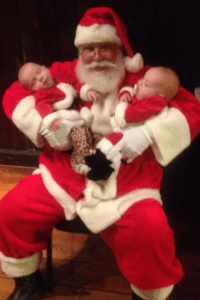
Santa, Baby

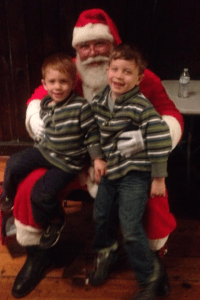
Grandtwins Madison and Matthew:

Santa4

Santa6

Santa7

Santa-Twins 2

Grandsons Gabriel and Daniel:

Santa5

Santa3

Santa2

Santa1

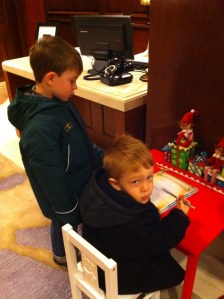
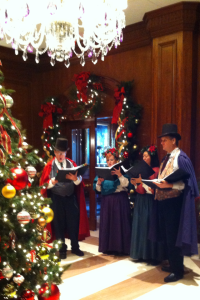
Most awkwardly funny moment of the holiday so far–wait, let me set the scene.   We were in the incredibly beautiful and highbrow lobby of the Ritz-Carlton–Buckhead in Atlanta over the weekend.  Just past these Dickensian carolers:

Santa9

Santa10

Resplendent Santa standing by the fireplace, creating a perfect Christmas tableau, with adoring children all around.  Without warning and with great, earnest conviction, five-year-old grandson Daniel yelling, “He’s a Fake!”  His parents threatening loss of Christmas coming.

Joyful Christmas to you!

wpid-Photo-Dec-24-2012-938-PM.jpg

Neal1

Posted in Savannah Joy

Jones Street

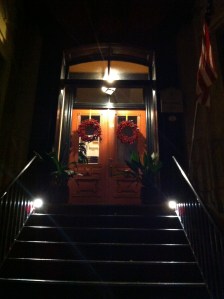
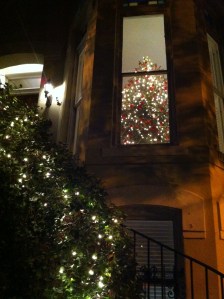
Jones Street, in Historic District Savannah, exudes grace, grandeur and the beauty of yesteryear at any season–but especially so at Christmas time.  Last night I took a holiday stroll down her brick and cobblestone sidewalks.

A sampling of the visual feast I enjoyed:

Jones 50

Jones 52

Jones 49

Jones 48

Jones 42

Jones 41

Jones 51

Jones 46

Jones 54

Jones 55

Jones 34

Jones 38

Jones 31

Jones 33

Jones 32

Jones 35

Jones 29

Jones 28

Jones 30

Jones 24

Jones 26

Jones 21

Jones 13

Jones 45

Jones 15

Jones 14

Jones 11

Jones 8

Jones 7

Jones 6

Jones 10

Jones 3

Jones 2

Jones 5

Jones 17

Jones 18

It’s amazing what beauty you see when you look for it.

Jones 47

Posted in Holiday Joy, The Joy and Wisdom of Children

Gratitude Turkey

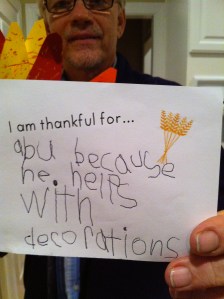
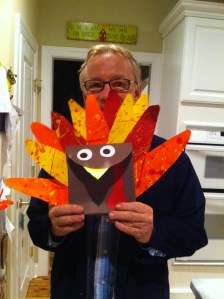
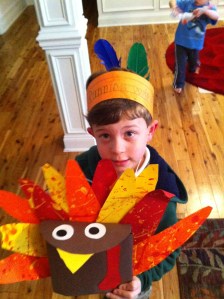
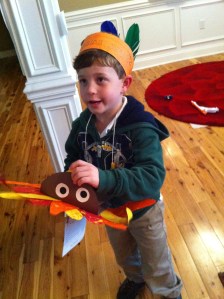
I picked up Grandson Daniel (5) from school yesterday, and, hopping into his back seat, he excitedly showed me his just-completed Turkey Basket (well, that’s what he called it anyway).  As I soon learned, the turkey project was two-fold: first the cute little construction paper turkey itself.  But as you can see in the pictures below, the front housed a nifty envelope (basket?) which held little gratitude or thanksgiving cards.  For each note, Daniel and his classmates completed the statement “I am thankful for ____ because …” for their family members.

What a joy!  Little ones expressing their thankfulness so sincerely.  Below Daniel explains to me that his plan for Thanksgiving Day consists of waiting till “all the guests” have eaten “some of their turkey” and then “hand out the slips.”  And he did just that–for all fourteen of the folks at the table.  His mom helped him with some of the spelling, but the sentiments were exclusively his.

Here’s mine:

“I am thankful for Abu (that’s me) because he helps with decorations.”

(Okay, maybe that sounds a bit strange, but the day before, we had decorated for Thanksgiving with some outdoor lights.  And a month earlier we had carved two jack o’ lanterns.)

What Thanksgiving Joy!  We really all do have so very much to put in our Turkey Baskets.

[For more on “Abu” see “My Favorite Word Is Abu!” post.]

Posted in College Teaching

“Blessings”

Each Monday morning up at my old hunting ground, Georgia Southern University, my buddy and former Writing and Linguistics Department colleague Eric Nelson shares a poem on the W & L listserv.  Yesterday’s poem was so joyful and encouraging, I thought I would share it with you, Kind Blog Readers.  It’s called “Blessings”:

 
Blessings
occur.

Some days I find myself
putting my foot in
the same stream twice;
leading a horse to water
and making him drink.
I have a clue.
I can see the forest
for the trees
.

All around me people
are making silk purses
out of sows’ ears,
getting blood from turnips,
building Rome in a day.
There’s a business
like show business.
There’s something new
under the sun.

Some days misery
no longer loves company;
it puts itself out of its.
There’s rest for the weary.
There’s turning back.
There are guarantees.
I can be serious.
I can mean that.
You can quite
put your finger on it.

Some days I know
I am long for this world.
I can go home again.
And when I go
I can
take it with me.

—Ron Wallace from Long for This World (U of Pitt Press, 2006)
**************************************************************************
Isn’t that a cool piece of writing?  I LOVE being reminded that … good happens.
***************************************************************************
***************************************************************************
Posted in Holiday Joy, Savannah Joy

Oh My Golly! My First Diwali!

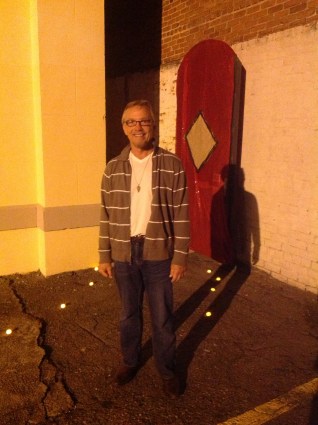
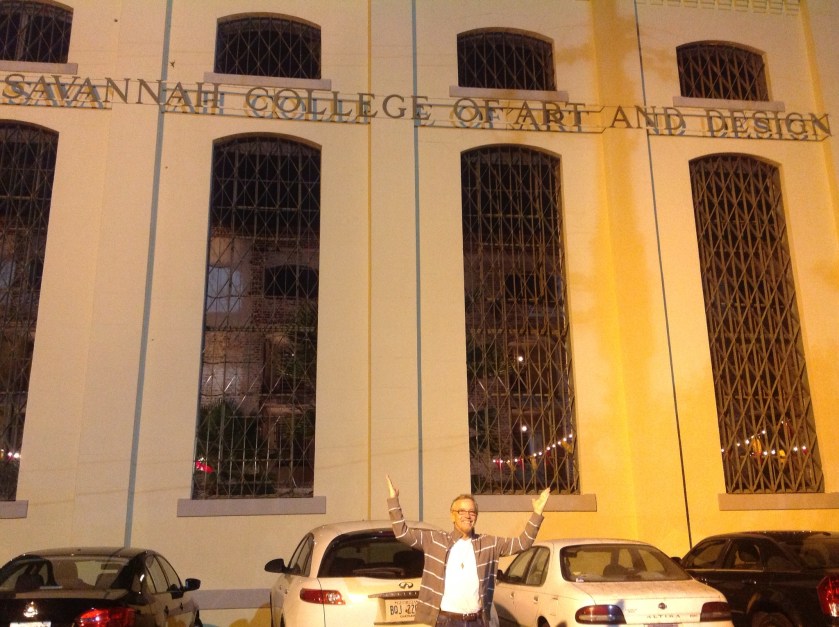
My new adjunct professorship at SCAD (Savannah College of Art and Design) in Language Studio/ESL comes with some very cool perks.  One is enjoying the beauty and history of SCAD’s many restored and repurposed buildings scattered across the Historic District of Savannah.  (Most of SCAD’s buildings are not new–more often than not, they were derelict or ready to be torn down before SCAD came to the rescue.)  My office, for example, is in Habersham Hall, part of the old Savannah jail.  (No more comments about finally being where I belong, please.)

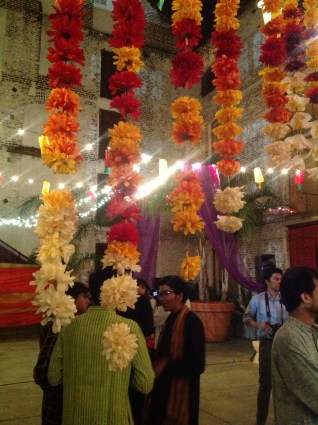
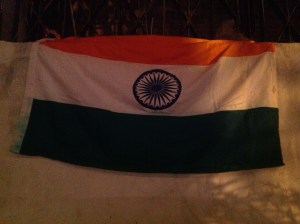
Another perk is being exposed to so many unique cultural opportunities (for example, the Savannah Film Festival started this weekend).  On Friday night, I ventured over to the Habersham courtyard to celebrate Diwali, or the Indian “Festival of Lights.”  Diwali, or Deepavali, is a major Hindu festival that celebrates the triumph and victory of good over evil, specifically when the Hindu God Rama defeated the demon Ravana.  Celebrations incorporate the lighting of lamps and fireworks to symbolize hope, restoration and joy.  That’s right up my blog’s alley!

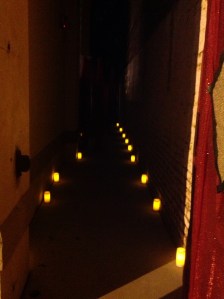
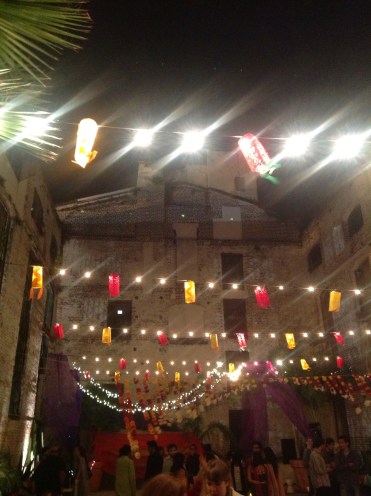
Turning the corner at the end of that mysteriously dark walk, I was amazed to see what looked like an Indian street festival in full swing.  Just look!

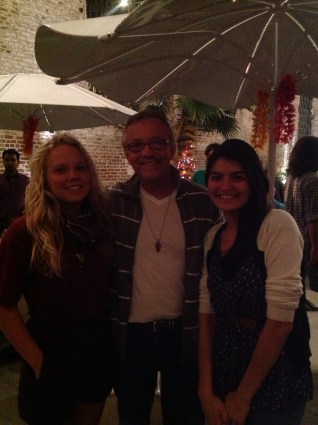
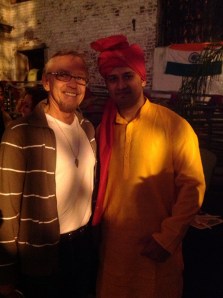
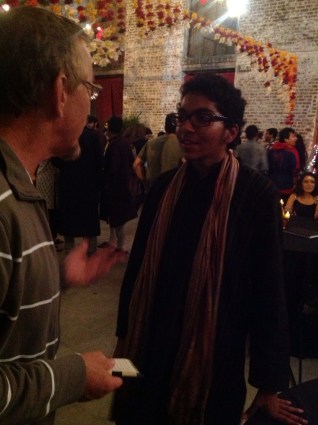
A large group of folks, many in traditional Indian garb, hovered around the food area.  And for good reason–the aromas were enticing.  The music was body-swaying.  Of course, I wanted to make a bee line directly to the grub, but I saw two of my students from ENGL 193 (Composition for International Students) and felt I had to pretend to be mature and say hello.  Here’s Kathrine and Stefanie:

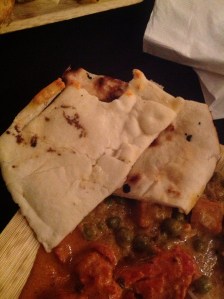
But oh gosh, the food!  I can’t remember any of the specific names, except for naan (the bread), but here’s my plate:


After stuffing myself to an embarrassing degree, I finally came back to my other nongastronomic senses and saw on the other side of the courtyard in the stage area another of my students, Aakash Mani (aka Cash Money!  Really!).  I made my way toward him, stopping to say hi to some of these folks along the way:

I finally made it to Aakash …

… and discovered that he was one of the stars of the entertainment part of the evening!  Here he is dancing up a storm!

After the performance, I asked Aakash what made him happy about Diwali and the festival.  He explained that the festival itself, because of its recognition of the triumph of good, is reason to celebrate, that it’s all about happiness, and that the very smile on his face (which is almost ALWAYS present) is there because of the joy of life.  He also said that dance shows happiness.  (That sounds like an A+ answer to me.)

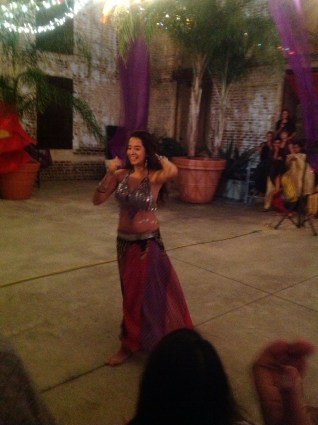
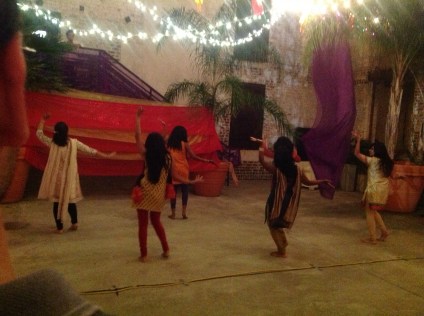
Other entertainers:

(Should I take up belly dancing?)

I was amazed at the beautiful orchestration of the evening.  So much fun!

I didn’t want to leave.

I love this place!


Posted in Joy in Nature

Elephant Ears & Spiritual Readings

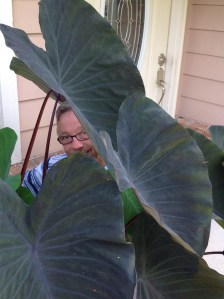
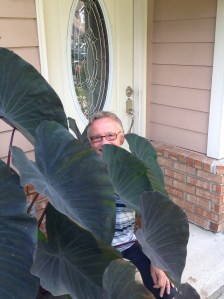
Is there a botanical specimen you’re just WILD about?  There certainly is for me!  It’s the Elephant Ear (Colocasia esculenta in plant taxonomy).  And not just because they make my big ears look smaller (though, of course, that’s part of it).  Elephant Ears also exude a mysteriously mystical and magical quality.

Okay that sounded rather silly and new age-y.  So I’d better explain.  But when you hear the WHOLE story, DO NOT JUDGE ME!  Or at least do not judge me too harshly.  Deal? 

Well, I have always simply adored the Elephant Ear family of luciously leafy plants.  But my REAL love affair with EE’s heated up last October when I trekked to New Orleans to make an academic presentation at the Popular Culture Association in the South annual conference.  Really, I’m telling the truth.  Okay, fine, here’s proof:  a blurb from the conference program:

Saturday 11.8 Pedagogy

“A Presentation Software By Any Other Name: The Light and the Dark of Shakespearean Powerpoint Presentations in College English Classrooms” Mark King and David Janssen, Gordon College

“The Visual Essay: Thinking and Playing Outside the Paragraphs” Neal Saye, Georgia Southern University

“Teaching Students to Write for TV and Film: A Comprehensive Plan for the Undergraduate Dramatic Scripting Course” Michael Moeder

So maybe mine doesn’t sound quite as smart as the other two.  But I had lots of visuals, with continual streaming over two screens!  And handouts!  And samples of student work!  And I gave out colored construction paper and had everyone do little projects!  (My hypothesis is that a few bells and whistles, along with hands-on tinkering, can make up for intellectual depth.  And besides, it was Saturday morning, for heaven’s sake.)

[The Elephant Ear connection is coming, I promise–just give me a minute or two.]

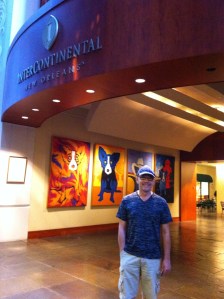
When I got to the Hotel InterContinental on St. Charles to check in, I used the Winning Strategy a friend taught me years ago: ALWAYS ask if an upgrade is “possibly available.”  But BEFORE you ask, set the stage: say something either Pitiful with a Touch of Humor (“I’m SO glad to FINALLY get here to your BEAUTIFUL hotel. My flight was SO turbulent!  I prayed more in those two hours than I have in the past two decades!  But what a peaceful aura both in this gorgeous lobby AND coming from you!  Thank you so much!” or something excitedly exuberant, again with an attempt at a tad of humor (“New-Party-Orleans!  I’m HERE!  And you’re my INCREDIBLE host/hostess!  Can you show me around when you get off work?  THANK YOU for having me!  You RULE this city!).  Then smile like you’re high on beignets and plead for the upgrade.  IT WORKS.  SO VERY OFTEN.  Try it.

I did.  And Bam!  I was given a Club Level upgrade with full food and drink privileges and a nifty elevator key card that whisked me up to the exclusive Executive Floor.  (Another thing, always buy a thank you card and give it to your benefactor during your stay.  It’s good karma.)

Swinging from chandelier in “the club”:

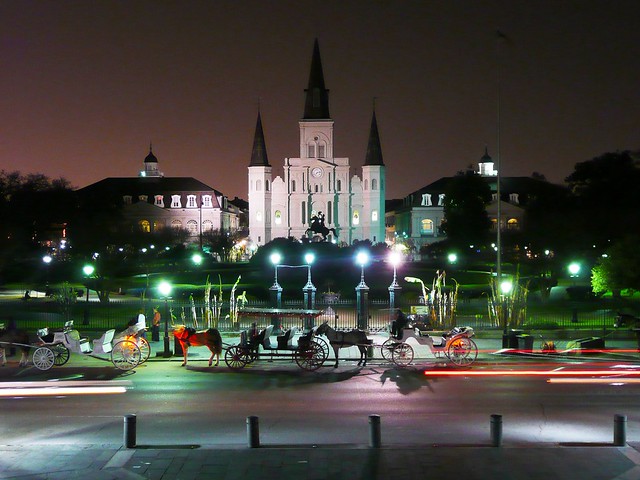
So the second night in Nawlins, after Wandering around Bourbon Street and Wondering, both quietly to myself and out loud to my fellow conference attendee friends, “Do those people on that balcony KNOW they are sorta naked?” and “Why am I catching all these beads?  I have forty strands now”  and “That’s a real alligator that monkey is holding, isn’t it?!” I left the decibels and the adult circus, and meandered over, first to sweet Cafe Du Monde, and then to Jackson Square.

With powdered lips I walked the square’s perimeter, taking in the colorful display of late night street performers, vendors and musicians.

My watch yawned midnight, but my heart gave me the injunction: walk around the square again, and if I make “comfortable, knowing” eye contact with a spiritual reader, I will stop and, uh, be read or whatever.

I walked slowly, my footfalls methodical and audible.

Two-thirds around, I saw her.

A tiny, wisp of a woman from the islands wearing a bandana and clenching a shawl in the sticky October heat.  She sat at a card table.  Breaking eye contact first, I walked on, feeling silly.  So we made eye contact–but “comfortable and knowing”?  I don’t think so.  Looking back confirmed my foolishness.  Her gaze had dropped.  Nothing but a bird-like woman beginning to close up shop.

Until she turned her body toward me and smiled.  A caramel Mona Lisa.  An inviting mystery.

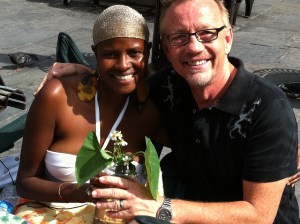
Thirty minutes later I walked away from Ms. Michelle with 1) a small elephant ear plant wrapped in wet paper towels and 2) ears resounding with what I had heard.

“You live near moving water, a river, an ocean, which is good.  Go embrace it often.  You need the movement of water.  You’re too rigid.”

Many other words and images left me, not shocked or awed by their relevancy and accuracy, but at peace with the connectedness of us all, the encouragement of strangers who are not strange after all.  Oneness.

“What do you want to ask?

I had two queries.  The first concerned the number four (my favorite number).  I loved her mathematics.  They confirmed what I knew–that all is well.

The second, as I took in the sight and smell of her small display of Mason-jarred summer leftover blossoms and greenery: “May I have that elephant ear?”  The green beauty had caught my eye from the start, small but holding its own, even without vibrant yellow or red.

“Of course.  It’s for you.  Take it.  Plant elephant ears, pick them.  Put them under your pillow.  They are health and good to you.”

Maybe I gave Michelle all the answers by coming to her, by asking questions.  Maybe I heard what I knew already.  Maybe I embraced the sugary night too tightly.  But I walked away buoyed by knowing.  Knowing that encouragement takes a myriad of forms.

*****************************************************************************

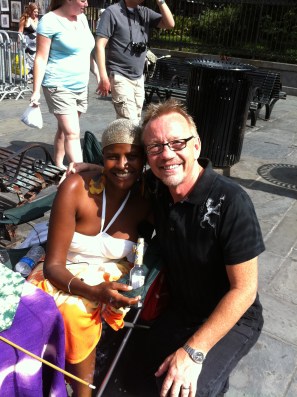
Unexpectedly I saw Michelle the next day in the sunlight.  We hugged and smiled, amped up in the brightness, having taken care of deep talk the night before.

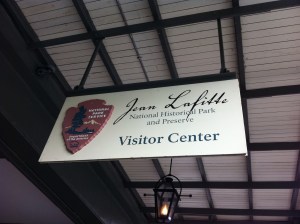
Later in that final day of my New Orleans stay, I stumbled across the Jean Lefitte National Historic Site and Preserve.

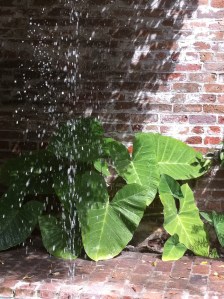
But what was REALLY cool is what I found there:

Water.  And Elephant Ears.  Across the street from the mighty Mississippi River.

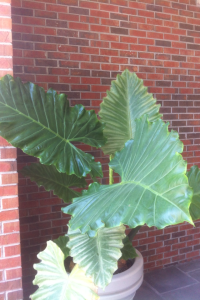
Back home in Savannah, one day I strolled the campus of Armstrong Atlantic State University, and here’s what I found:

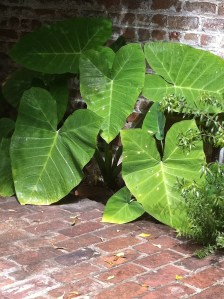
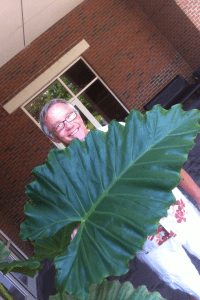
Huge Elephant ears.

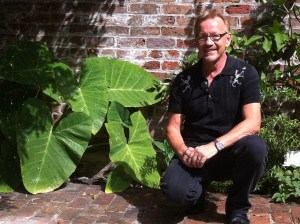
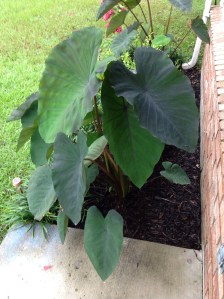
Oh, I planted my own Elephant Ears.  This summer they grew beautifully:

(Excuse me for looking a bit like Captain Kangaroo in the above pic.  Google him, kids.)

Moral of story (at least for me):  Listen.

Posted in JoyInciters

JoyInciter # 4 — The Three Candles

Today I am sharing with you JoyInciter #4.  (Actually I briefly mentioned this strategy when I guest blogged on David’s terrific London-based 5thingstodotoday site recently.)

In my first post about JoyInciters, I defined them as a collection of simple practices or strategies which I use regularly to increase the level of happiness and joy in my life.  The first JoyInciter–the Thanksgiving Book (or Gratitude Journal), the second one–the Walking Into strategy, and the third–the Happiness Box,  are all techniques to make us more joyful in our day-to-day lives.

I love JoyInciter #4 — The Three Candles, because of its sensory simplicity yet powerful lesson.  Find three candles (any size or type will do).  Choose a quiet place where you can be comfortable and preferably alone.  Light your three candles.  Stare at them for a few seconds.  See the first candle as representing your past, the second your present, and the third your future.

Now move your awareness to the first candle.  The past.  Admit that you cannot really live in the past, it’s over, and regret is both painful and a useless waste of mental energy.  Living in the past keeps us out of healthy BALANCE mentally and even physically.  Bless the past with love as best you can … and let it go, as you blow the first candle out.  Release.

Now look at that third candle.  The future.  Realize you cannot reside in the future; it’s not here yet.  Worry about the future (like past-oriented regret) costs us our joyful mental health because we are trying to BE in a place where we never CAN be–the future.  Try saying this, “All will be well.  I will be well” and blow out candle #3.

Look at the second candle glowing in its oneness, its all-there-isness, its currentness, its presentness.  It’s your Now.  Think about this truth for a moment: the ONLY time any one of us ever really has is RIGHT NOW.  Everything is NOW.  When all is said and done, NOW is all there  is.  Keep this candle glowing for a few moments as you contemplate on a handful of positive aspects of your Now.

EnJoy JoyInciter #4 — The Three Candles.

Posted in Life Experiences, Neal's Writing

Learning and Teaching from The World’s Smallest Lady

August–the time of year when school bells ring again.  Teachers everywhere commence their incredible annual charge of encouraging students to develop their true sight, their true voices, and their intellectual joy.  School at every level should be a haven where young learners want to be.  And the teacher, though underpaid and overworked, is key.  Some years back, as I spent a summer month participating in the Georgia Southern Writing Project, I was asked to write about what birthed the teacher in me.  I knew immediately the answer: The World’s Smallest Lady.

small fair

The World’s Smallest Lady

As I dialed the telephone recently to check on the condition of the terminally ill father of a childhood friend from my hometown, I kept trying to keep the memory from surfacing.  I hadn’t thought about it in ages.  An incident from several decades ago surely didn’t still have the power to take control of my thoughts, to interrupt my life.  But the truth is, that memory is too powerful to ignore, too embarrassing, too haunting to dismiss.  And as I listened to Ricky’s phone ringing in one ear, the years faded, and the jumbled noises of an old Cherokee County Fair started sounding in the other, accompanied by reminiscent sights and even smells, which are such an integral part of a southern autumn carnival…

…I was thirteen, old enough to know better.  Ricky, Fred, and I had just staggered off The Bullet and found ourselves walking down Freak Show Alley.  Outside one attraction, a hawker was shouting at passersby to “Step inside and see The World’s Smallest Lady!  Only twenty-six inches tall!  For only a quarter!”  So, laughing, into the tent we hurried, just the three of us.

And there, surprisingly close to us on a small black round table, stood what indeed had to be The World’s Smallest Lady.  She was dressed in a little gaudily sequined gypsy outfit.  A short screaming-red skirt revealed two chubby stumps of legs.  But she wasn’t a child, even though she was so tiny.  Her face looked old, and I could see wrinkles beneath the cheap, garish make-up.  It was her very large head, however, topped with a gaudy, shiny gold crown, which really captured my attention.  I couldn’t stop staring, and why should I?  I’d paid my quarter.

So we gawked and snickered, three carefree young teenagers at the fair, secure and even innocent in our youth, our health, our futures, our “normality.”  Then Fred loudly whispered, “Damn, y’all, look at the size of that head compared to the rest of her body.  And her butt is bigger than mine!”

But it was Ricky, the member of our inseparable trio capable of doing and saying anything for a laugh–who, in reckless teenage cruelty, did the unimaginable.  Before anyone had time to react, Ricky stepped over the velvet rope, reached out to The World’s Smallest Lady, and jerked her gypsy skirt down to her ankles.  He ran out of the tent, followed by Fred, giggling and yelling, “Neal, let’s get out of here!”

But I couldn’t.  My feet were glued to the sawdust, and for a second or two, my eyes looked directly into those of The World’s Smallest Lady.  The dimension of time ceased, no one existed except for her and me, and those humiliated, prostituted, tiny eyes took away my innocence and my security.  As I stared, and stared, the plates beneath my small, comfortable, well-defined earth were shifting, ever so slightly, quaking.  Finally, as she reached down, pulling up her skirt to cover her nakedness, The World’s Smallest Lady spoke in a voice that seemed more resigned than angry: “You boys can just go to hell.”

As I hurried out of that tent and away from that sawdust and those piercing eyes, a startling transformation occurred, the full impact of which I wasn’t aware at the time: a sideshow midget, a twenty-five cent carnival attraction, a freak, became a regular human being with regular human feelings in the frightened yet awakening eyes of a thirteen-year-old boy.

guys

***************************************************************************************************************************************

I learned from my encounter with The World’s Smallest Lady the danger and horror of living in a world where we construct walls which establish the category of “other”–with ourselves being the privileged, the truly knowledgeable, the valuable, the ones who really count, the normal…and “other” being defined by gender, race, class, IQ, physical disability, sexual orientation, etc.  I learned that when we cast our dominant “gaze” patronizingly on others, we diminish ourselves as human beings as well as do violence to those we belittle.  I also learned–years later and after much reflection and life experience–that a teacher is one who refuses to allow the binary of “us/them” to operate in (or outside) the classroom.

May the new school year be one of JOY for students and teachers the world over.


Posted in Encouragement

“You Is” — I’m Standing in Your Balcony

To Encourage Sincerely perhaps ranks at the top of gifts we can give one to another.  I will never forget the first time my daughter Amy and I ran, with tens of thousands of other runners, the annual July 4th 10K Peachtree Road Race in Atlanta.  (Perhaps “ran” is much too dynamic a word to describe what I did during those 6.2 miles.)  At each mile marker, and actually various places in-between, folks would appear in my peripheral vision with cups of cold water in outstretched hands, yelling phrases such as, “Keep it up, #4932, you can do it!” and “Just look at you running so fast!”  I would turn a corner or reach a hilltop and hear blaring cheerily from loudspeakers the theme song from “Chariots of Fire” or “Rocky.”  Such encouragement made me feel like an actual runner.

In a post from way back, I introduced the concept of Balcony People:  “Balcony people are those folks in your life who encourage you, lift you up, give of themselves to you in some way.  They make you feel valuable and important.  They climb the steps up into your balcony, lean over the railing, gaze back down at you as you struggle through life and yell, ‘You can make it!  Keep going!'”

In another post, Balcony People-Part Two, I introduced five guiding principles of Balcony People:

“1.  Balcony People are willing to take risks.  Because when we reach outside of ourselves to help or encourage someone else, we take the chance of being rejected, laughed at, embarrassed, or even thought of as a little weird.  ‘Old Man Saye, why do you keep telling me my yellow dress is just so very pretty?!  Please back away me!'”

2.  BP realize that what you reap, you sow.  Staying in balconies makes you happier and healthier.  Crouching in dank basements is unhealthy.

3.  BP give to give, not to get.  Because giving away good to others is simply the right thing to do.

4.  BP look for the good in others.  They realize the truth of the statement that we usually find what we’re looking for.

5.  BP express encouragement sincerely.  They don’t flatter or lie.  Okay, maybe except when I couldn’t think of anything good to say about one student’s essay, and all I could come up with was, ‘Cool font.'”

I know I have mentioned on the blog before that Kathryn Stockett’s The Help stands as one of the best novels I have read in the past few years.  I loved the story of black maids in the 1960’s south so much that I used it in several composition classes at Georgia Southern.  The book went over amazingly well, with many students telling me that they loved the book and would be passing it along to friends and family to read (and also telling me, disturbingly, that the book was the first one they had ever actually ever gotten all the way through).  The book ENCOURAGES the voiceless to realize that yes, they too have voices.
In the twenty-second scene below from the movie version of The Help, Aibilene explains to her young charge exactly what the girl is, and what she needs to believe about herself.  Oh, how our world would be beautifully improved if we would all see each other the way Aibilene sees Mae Mobley.

*******************************************************************

I challenge you to find someone today, tomorrow.  Encourage.  Lift up.  See the good.  Get in someone’s balcony.